Products / Cellular / honeycomb blinds
An insulating buffer for the room that stays cold
Pleated fabric forming hexagonal air cells — a soft thermal buffer that earns its keep on the shaded, forest-facing side of a Tokai home, where a wall or window rarely gets a full afternoon to dry out or warm up.
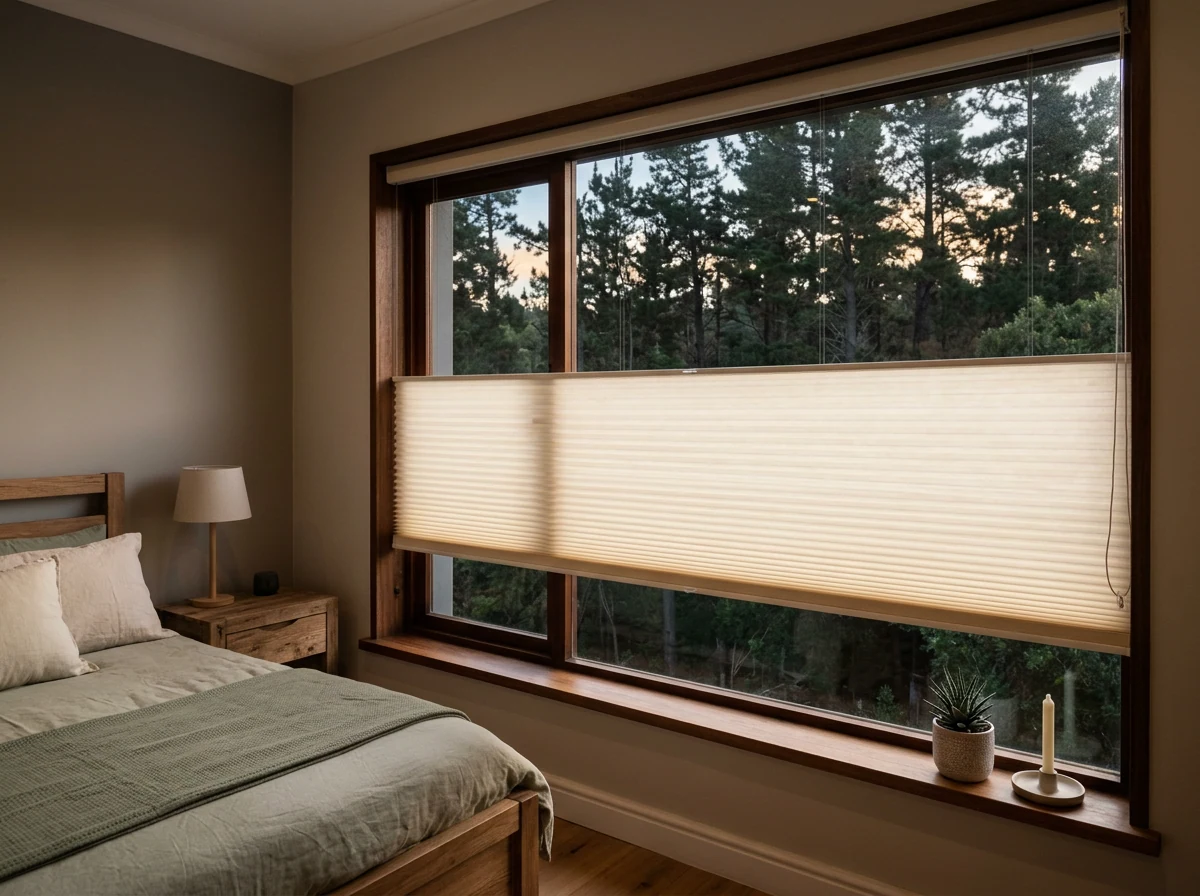
Every Tokai home has one — the room that’s always a little colder than the rest, usually the one facing the plantation rather than the street. Trapped air is genuine insulation, and a cellular blind puts a soft buffer of it directly against glass that’s losing heat to a shaded wall outside. It’s not a fix for the whole house; it’s a targeted answer for the specific rooms that need it.
The honest thermal case
Single cells suit a mild room; double cells do more work in the room that runs genuinely cold through a Cape Town winter, or holds heat awkwardly on the rare hot forest-shaded day. The cells also absorb a noticeable amount of sound, which helps in a bedroom close to a busy road frontage. We keep the claims qualitative — comfort and a lower heating load, not invented percentages.
Where it earns its place in a Tokai home
- Nurseries and bedrooms on the forest-facing side, where blockout cell fabric gives genuine darkness plus the thermal bonus.
- Renovated additions with more glass than the original build, where the room above a garage or a new glazed extension is “always freezing.”
- Top-down/bottom-up operation for a street-facing window — privacy at the bottom, light and sky at the top, without losing the thermal benefit.
What a honeycomb costs
Guide figures, per square metre, installed. A corded or cordless cellular blind runs roughly R1,500 to R2,800 per square metre — a single cell in a light-filtering fabric at the lower end, a double cell or a blockout-lined cell at the upper, where most of the thermal work happens. Motorised, budget roughly R3,000 to R4,800 per square metre, which is the band for a top-down bottom-up bedroom blind or anything on a tall gable window.
Small openings carry a minimum charge, because the headrail, brackets and time on site barely change with the size of the glass. Treat the figures as a way to plan: your own windows are priced after the free measure and given to you in writing before production starts.
Nursery and bedroom insulation for family homes in Bergvliet and Meadowridge, older farm-style homes with genuinely cold rooms around Constantia, and new-build additions on Steenberg’s estate properties.
Let’s find out which rooms actually need it.
The measure costs nothing, the quote is itemised window by window, and you get a straight answer on single versus double cell.